Projects


Guide: Prof. Sankara Subramanian, Associate Professor,
Department of Engineering Design, IIT Madras
Duration: August '14 - Present
Keywords: Eigenfunction Virtual Fields Method (EVFM); orthotropic elasticity; full-field measurement; Principal Component Ananlysis; inverse problem; noise.
General overview of EVFM and DIC
The Virtual Fields Method and the Eigenfunction Virtual Fields Method (EVFM) are inverse techniques for estimating constitutive properties from full-field experimental data. We obtain full-field strain data using the optical technique, Digital Image Correlation, which involes the following steps:
What is EVFM?
S.J. Subramanian, 2013, The Eigenfunction Virtual Fields Method; presented at the XIII Annual SEM Conference, Lombard , IL, USA
-
Prinipal Component Ananlysis (PCA) of measured strain fields is performed through Singular Value Decomposition
-
Left and Right eigenfunctions (columns of L and R) are used to generate virtual strain and displacement fields
-
Use of virtual fields in the Priniciple of Virtual Work leads to a system of (possibly non-linear) equations in , the material parameter vector,
Abstract
The Virtual Fields Method (VFM) and the Eigenfunction Virtual Fields Method (EVFM) are inverse techniques in which a set of virtual fields is used in the Principle of Virtual Work (PVW) to yield a system of algebraic equations for the unknown material parameters. In a typical experiment, one does not know the distribution of tractions over the external surface of the specimen, but the total force is generally measured. In order to still enable evaluation of the external virtual work integral that appears in PVW, the virtual displacements are commonly restricted to be uniform over the portion of the exterior surface where tractions are prescribed so that the external virtual work is simply the inner product of the known total force vector and the uniform value of the chosen virtual displacement vector.
In this work, we relax this constraint and obtain a more exible version of EVFM which enables us to probe at small-subset scales inside the domain of interest. The proposed modication is used to obtain orthotropic elastic constants from a simulated unnotched Iosipescu test, and is shown to yield much tighter estimates in specific subsets than previously obtained wherein the boundary virtual displacements were constrained to be uniform. The removal of the constraint also results in an EVFM formulation capable of dealing with material heterogeneity, missing data and discontinuities in specimen geometry.
-
Sequential digital images of the region of interest are acquired through the course of deformation
-
Pixel-subsets are tracked from one image to the next through a minimization process to obtain the affine parameters
-
The displacement of the pixel subset is computed as an output of the minimization from the obtained affine parametes
-
Strains are computed by smoothing and differntiating the displacement field


Unnotched Iosipescu setup - initially used for characterizing composite materials since a combination of shear and bending deformation modes occur. Inspired by this, we extend it to obtain heterogeneous strain-fields.

The set of equations arising out of the four chosen virtual fields. Noise in strain fields gets cascaded to these coefficients affecting the accuracy in orthotropic parameter estimation.


Contour maps of the three 2D strain components obtained from finite-element analysis, showing concentration near support edges. With the extended EVFM formulation, we are no longer constrained to choose the entire domain. We are interested in regions of small subset sizes, where very high accuracy in material property estimation can be expected.
Spatial map showing very small subsets locations (in deep blue) inside the region of interest where close to accurate orthotropic elastic moduli values are obtained. Antisymmetry about the central point is observed as expected. Correlation between spatial maps of different strain-based measures and the spatial map shown here yields conditions on domain locations for high-fidelity material property estimation.
Milestones in this work
-
Successfully obtained in-plane orthotropic elastic moduli with the modified EVFM formulation.
-
Accurate values (<0.1% deviation) are obtained at a range of subset locations for the noise-free case.
-
Working on establishing a strain-gradient based measure for identifying domain locations with high-accuracy in moduli computation.
-
Studying the correlation between noise-sensitivity and a few gradient based measures.

2. A methodology for hyperelastic property characterization of carbon-filled rubbers
Guide: Prof. Sankara Subramanian, Associate Professor,
Department of Engineering Design, IIT Madras
Duration: August '13 - July '14
Keywords: Eigenfunction Virtual Fields Method (VFM); hyperelasticity;
full-field measurement; inverse problem; novel specimen
for planar setup; specimen optimization; buckling.
Abstract
Eigenfunction Virtual Fields Method (EVFM) is an inverse computational technique for obtaining constitutive parameters using full-field experimental data. In this work, we extend the EVFM formulation to characterizing carbon-filled rubbers using the Ogden model for hyperelasticity. A novel specimen is designed for obtaining heterogeneous strain-fields in the case of a planar test setup. Achieved heterogeneity is measured based on I - I strain-invariant map for the induced strain-fields. Since analysis of initial experimental data using Digital Image Correlation (DIC) yielded spurious 2D strains at locations with large out-of-plane displacements due to transverse compressive-stress induced buckling, it was identified that true strains can be captured if the out-of-plane displacement is not large. A parametric study is performed using several finite-element models to arrive at optimized buckling-free specimen dimensions. 2D strain-fields obtained from the novel specimen are used in the EVFM formulation for hyperelasticity in order to obtain material parameters.
Initial results have been presented at the European Mechanics of Materials Conference (EMMC-14), 2014, Gothernburg.
Link to the conference proceedings.
The conference presentation can be viewed here.
The abstract submitted to the conference can be viewed here.
Milestones in this work
-
Designed and optimized a novel specimen to obtain heterogenous strains using a planar test setup.
-
Devised an EVFM formulation to obtain 3rd order Ogden paramters for hyperelastic materials like carbon-filled rubbers.
-
Carried out experiments with multiple relaxation steps for obtaining hyperelastic parameters; captured full-field strain data using 3-D Digital Image Correlation (3D-DIC)
References
-
Nigamaa, N., and S. J. Subramanian. "Identification of orthotropic elastic constants using the Eigenfunction Virtual Fields Method." International Journal of Solids and Structures 51.2 (2014): 295-304.
-
Subramanian, Sankara J. "The eigenfunction virtual fields method."Advancement of Optical Methods in Experimental Mechanics, Volume 3. Springer International Publishing, 2014. 35-42.
-
Working on establishing a strain-gradient based measure for identifying domain locations with high-accuracy in moduli computation.


Schematic of the novel specimen and the applied displacement boundary-condition

The induced strain fields (experimental data)
The invariant plots obtained from strain-fields by both experiments and finite-element analysis (before parameter estimation) show a high degree of heterogeneity.
1. EVFM for orthotropic parameter idenfication extended to geometric discontinuities and material heterogeneity


Max. principal strain Min. principal strain Shear strain in naive basis
References
-
Lion, Alexander. "A constitutive model for carbon black filled rubber: experimental investigations and mathematical representation." Continuum Mechanics and Thermodynamics 8.3 (1996): 153-169.
-
Sasso, M., et al. "Visco-Hyper-Pseudo-Elastic Characterization of a Fluoro-Silicone Rubber." Experimental Mechanics 54.3 (2014): 315-328.
3. Estimation of spatially varying elasto-plastic parameters using Virtual Fields Method (VFM)
-
Performed uniaxial tension tests on specimens sliced out of cylindrical friction stir welded (FSW) stainless steel rods.
-
Spatially varying elasto-plastic constitutive law of the Voce form is assumed to govern displacements and spatially dependent parameters are computed using the Virtual Fields Method (VFM).
-
Principal Component Analysis of strain fields is performed to reveal primary deformation patterns.
Guide: Prof. Sankara Subramanian, Associate Professor,
Department of Engineering Design, IIT Madras
Duration: Nov '12 - Present
Keywords: Eigenfunction Virtual Fields Method (VFM); elasto-plastic paramteres; spatially varying properties; friction-stir welding; strain bands; Principal Component Analysis (PCA); inverse problem
Abstract
We report on an analysis of deformation fields obtained from uniaxial tensile tests on specimens sliced out of cylindrical friction stir welded (FSW) stainless steel bars. The weld interfaces are oriented perpendicular to the loading direction and the deforming bar is imaged periodically and the images are analyzed using Digital Image Correlation (DIC). The full-field displacements and strains computed using DIC reveal diffuse necking and characteristic strain bands, with eventual strain localization and failure at strains of around 0.8. A spatially varying elasto-plastic constitutive law of the Voce form is assumed to govern the displacement of the bar material and the material parameters of this constitutive law are assumed to be periodic functions of the axial cooridnate. Far away from the welds, the properties of the base material are recovered.
The spatially dependent parameters are estimated using the Virtual Fields Method (VFM), which is an inverse technique based on the Principle of Virtual Work (PVW). In VFM, the true stress fields are written in terms of the unknown material parameters and the measured strain fields and various virtual displacement and strain fields are substituted into PVW to obtain algebraic equations in the unknown material parameters. A cost function based on the sum of squared residuals of these equations is then designed and the minimization of this cost functions yields the desired material parameters. The obtained heterogeneous elasto-plastic constitutive law is compared to that of the base material and also correlated with the microstructure of the welded material. Finally, Principal Component Analysis (PCA) of the displacement and strain fields is performed to reveal primary deformation patterns along the length of the bar, and an attempt is made to also correlate these with the observed microstructure.
This work has been accepted for presentation at the International Conference on the Strength of Materials (ICSMA-17), 2015, Brno, Czech Republic.
The abstract submitted to the conference can be viewed here.
Milestones in this work
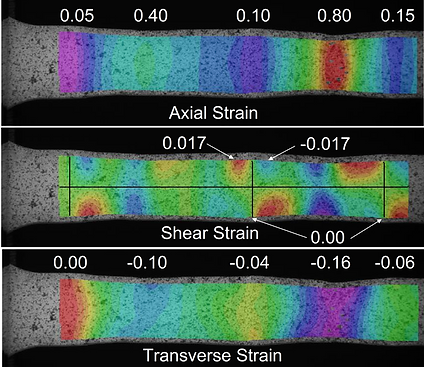
Contour maps showing axial, shear and transverse strain-fields. The full-field displacements and strains computed using DIC reveal diffuse necking and characteristic strain bands, with eventual failure at strains of around 0.8. It is evident that the base material is more compliant with necking occuring in there. Large shear strains are observed at the friction welded interface where there is a transition from one base metal segment to another.

Initially, 3D-DIC was attempted but it resulted in delamination of paint due to high-temperature at the friction-welding interface. Therefore, 2D-DIC was carried out on specimens sliced out of cylindrical friction-stir welded steel bars.
References
-
Rhodes, C. G., et al. "Effects of friction stir welding on microstructure of 7075 aluminum." Scripta materialia 36.1 (1997): 69-75.
-
Peel, M., et al. "Microstructure, mechanical properties and residual stresses as a function of welding speed in aluminium AA5083 friction stir welds." Acta materialia 51.16 (2003): 4791-4801.
-
Mahoney, M. W., et al. "Properties of friction-stir-welded 7075 T651 aluminum."Metallurgical and Materials Transactions A 29.7 (1998): 1955-1964.
-
Su, J-Q., et al. "Microstructural investigation of friction stir welded 7050-T651 aluminium." Acta Materialia 51.3 (2003): 713-729.
4. Bias-variance analysis of EVFM estimators for an orthotropic material

Guide: Prof. Sankara Subramanian, Associate Professor,
Department of Engineering Design, IIT Madras
Keywords: Eigenfunction Virtual Fields Method (VFM); bias- variance analysis; noise in strains; orthotropic- parameter estimation
Abstract
Eigenfunction Virtual Fields Method (EVFM) is an inverse computational technique for obtaining constitutive parameters using full-field experimental data. An important criterion in the choice of an inverse computational technique is the accuracy in obtaining constitutive parameters. Therefore, in this work, we quantize the maximum deviation in computing parameters by performing a bias-variance analysis of EVFM estimators. The bias and standard deviation for each EVFM estimator are computationally obtained for several orders of magnitude of noise-amplitude in strain-fields. The noise in strains is cascaded down through the entire EVFM formulation for orthotropic materials to analytically obtain expressions for bias and variance as a function of noise-amplitude in strains. At low strain levels, excellent agreement has been observed between analytically and computationally obtained results. This study provides us with the maximum allowed experimental noise for a given expected tolerance in orthotropic parameter estimation

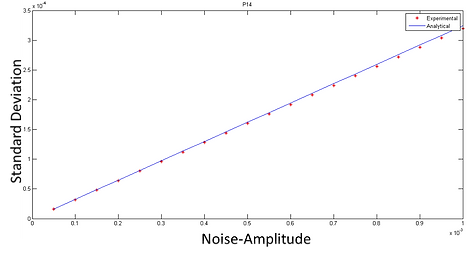
Plots for two representative EVFM estimators showing agreement between computationally and analytically obtained standard-deviation values for a range of noise-amplitude values.
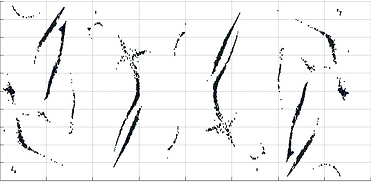
Strain fields (from top to bottom, transverse strain, axial strain and shear strain in naive basis) with highest noise-amplitude added. It can be observed that even in this case, wherein the actual deformation is not easily separable, there is agreement in variance values.
Milestones in this work
-
Analytically obtained Coefficients of Variation (CoVs) for each orthotropic material parameter as a function of noise-amplitude in strain computation using perturbation theory.
-
Computed CoVs confirm the analytically obtained linear relationship with noise-amplitude.
-
This provides a criterion for choice of sub-domain based on singular-value gaps of strain matrice
References
-
Nigamaa, N., and S. J. Subramanian. "Identification of orthotropic elastic constants using the Eigenfunction Virtual Fields Method." International Journal of Solids and Structures 51.2 (2014): 295-304.
-
Stewart, Gilbert W., and Ji-guang Sun. "Matrix perturbation theory." (1990).
5. Design considerations for off-shore wind turbines and heuristic rules for investment in wind technologies and energy sustenance
Guide: Prof. Amy J. C. Trappey, Professor, Department of industrial Engineering and Engineering Management, National Tsing-Hua University (NTHU), Hsinchu, Taiwan.
Keywords: Ecological footprint, energy-generation capacity, wind power, heuristic rules, renewable energy, turbine design and optimization
Abstract
Renewable energy has been increasingly promoted and used to substitute non-renewable fossil-fuels, which cause negative effect on the environment. This research discusses heuristic rules that can be used to choose a particular Energy Policy for investment at a given site of installation based on constraints imposed by considerations pertaining to the maximum acceptable ecological footprint, the minimum energy requirement for the plant and the maximum investment that can be borne. The paper mentions the cost learning models for the wind power and the photovoltaic power establishments. It also deals with the amount of energy that can be replenished from a given wind turbine of a given area and specification.
These serve as design guidelines before erection of off-shore wind turbines. Also, this research discusses as to how we can fix on parameters for wind turbines given that there is a fixed target for the amount of energy that needs to be achieved.
The article can be viewed here.
Milestones in this work
-
Optimized the dimensional parameters for strength and effective rotational energy replenishment.
-
Drafted heuristic rules for turbine-design and investment in wind technologies in order to maximize energy efficiency. This work engendered an article for Taiwan government's renewable energy ventures.

Plot showing variation of the replenished power versus the instantaneous wind velocity (losses increase at higher instantaneous speeds causing stagnation of power available for conversion)
Calculated costs per kWh of wind generated power as a function of the wind regime at the chosen site (number of full-load hours)

* Full load hours are the number of hours during one year during which the turbine would have to run at full power in order to produce the energy delivered throughout a year
References
-
Bhandari, Ramchandra, and Ingo Stadler. "Grid parity analysis of solar photovoltaic systems in Germany using experience curves." Solar Energy 83, no. 9 (2009): 1634-1644.
-
Paul-Erik Morthorst, Shlmon Awerbuch, “The Economics of Wind Energy,” European Wind Energy Association, 2009
-
Trappey, Amy JC, Charles V. Trappey, Penny HY Liu, Lee-Cheng Lin, and Jerry JR Ou. "A Hierarchical Cost Learning Model for Developing Wind Energy Infrastructures." International Journal of Production Economics (2013).
6. Intelligent transformer health prediction using Principal Component Analysis and Artificial Neural Network Modelling
Guide: Prof. Amy J. C. Trappey, Professor, Department of industrial Engineering and Engineering Management, National Tsing- Hua University (NTHU), Hsinchu, Taiwan.
Keywords: Transformer health, intelligent prognosis, gases in oil, engineering asset management, artificial neural network, principal component analysis


Abstract
Large sized transformers are an important part of global power systems and industrial infrastructures. An unexpected failure of a power transformer can cause severe production damage and significant loss throughput the power grid. In order to prevent power facilities from malfunctions and breakdowns, the development of real-time monitoring and health prediction tools are of great interest to both researches and practitioners. An advanced monitoring tool performs real-time monitoring of key parameters to detect signals of potential failure through data mining techniques and prediction models. Asset managers use the result to develop a suitable maintenance and repair strategy for failure prevention. Principal component analysis (PCA) and back-propagation artificial neural network (BP-ANN) are the algorithms adopted in the research. This paper utilizes industrial power transformers’ historical data from Taiwan and Australia to train and test the failure prediction models and to verify the proposed methodology. First, PCA detects the conditions of transformers by identifying the state of dissolved gasses. Then, the BP-ANN health prediction model is trained using the key factor values. The integrated engineering asset management database includes nine gases in oil as input factors (N2, O2, CO2, CO, H2, CH4, C2H4, C2H6, and C2H2). After applying Principal Components Analysis, five factors from the Taiwan operational transformer data and six factors from the Australia data are identified. The integrated PCA and BP-ANN fault diagnosis system yields effective and accurate predictions when tested using Taiwan and Australia data. The accuracy rates are much higher (i.e., 92% and 96% respectively) when compared to previous result of 69% and 75%. This research is benchmarked against the DGA heuristic approaches including IEEE's Doernenburg and Rogers and IEC's Duval Triangle for the experimental fault diagnoses.
I represented my research-lab and presented at the International Asia Conference on Industrial Engineering & Management Innovation, 2013, National Taiwan University, Taiwan.
Link to the conference website.
The conference presentation can be viewed here.
Milestones in this work
-
Principal Component Analysis was applied for detection of condition of transformer by identifying the state of the dissolved gases and the key factor values.
-
Industrial power transformers' historical data from Taiwan and Australia is utilized to train and test the failure prediction models and to verify the proposed methodology.
-
The Back Propogation - Artificial Neural Network health prediction model is trained using the key factor values and the diagnostic system yields effective and accurate predictions when tested using data from Taiwan and Australia.
References
-
Avci, E. & Turkoglu, I. (2009) An intelligent diagnosis system based on principle component analysis and ANFIS for the heart valve diseases, Expert Systems with Applications, 36(2), 2873-2878.
-
Booth, C. & McDonald, J.R. (1998) The use of artificial neural networks for condition monitoring of electrical power transformers, Neurocomputing, 23(1)-23(3), 97-109.
-
Brusic, V., Rudy, G., Honeyman M., Hammer, J. & Harrison L., (1998) Prediction of MHC class II-binding peptides using an evolutionary algorithm and artificial neural network, Bioinformatics, Vol. 14, No. 2, 121-130.
-
Ghunem, R.A., El-Hag, A.H. & Assaleh, K. (2010) Prediction of furan content in transformer oil using Artificial Neural Networks (ANN), IEEE International Symposium on Electrical Insulation (ISEI), San Diego, CA, USA, June 6-9, 1-4.
The architecture of BP-ANN model for transformer maintenance
System process flow for Principal Component Analysis
Other Projects
I have done several other course projects in the five years at IIT-Madras. I am listing them here for completeness.
1) Steering-module design of team IIT-Madras' race-car (2010-2012): The car stood second among all the IITs in the international design competition, Formula Student Germany, 2011. Web-link
2) Design of a low-cost SMS-based doorbell mechanism for the hearing impaired using an Arduino UNO chip. Report-PDF
3) Design of a mechanical elevator system using the charged-flywheel mechanicsm for infinite life. Report-PDF
4) Parametric study and optimization of a flywheel assembly for efficient energy storage. Report-PDF
5) Stair Climber - a mechanical device for assisting in transportation of heavy materials.
6) An empirical model to maximize flight-time using Latin Hypercube Sampling (LHS) design. Report-PDF
abs1odeabs2odepptodereport2odereport3odereport4odereportodeabstract-PDFodearticle-PDFodepresentation-PDF
presentation-PDFg all abstract-PDF
